Skip to content
Many local homeowners debate the cost of building a pergola, whether it is a good investment, and whether it will last in Texas’s brutal weather. A pergola that looks stunning in a showroom can become a warped, sun-bleached liability within three years if it was built with the wrong materials for a Texas climate. That is the reality many College Station homeowners discover after choosing the lowest bid or a big-box kit never engineered for 100-degree summers and the humidity that rolls in from the Gulf Coast.
How much does a pergola cost in the local area? Short answer: a professionally built pergola in College Station typically costs $5,000 to $30,000+, depending on size, material, site conditions, and whether it’s a custom pergola cost estimate. That range isn’t arbitrary — it reflects real differences in material quality, footing depth requirements for local clay soil, and how much of the structure is engineered versus assembled from a box.
This guide breaks down where that money goes, what size and material make sense for this region, and why the cheapest bid rarely wins in the long run.
What Drives Pergola Cost in College Station
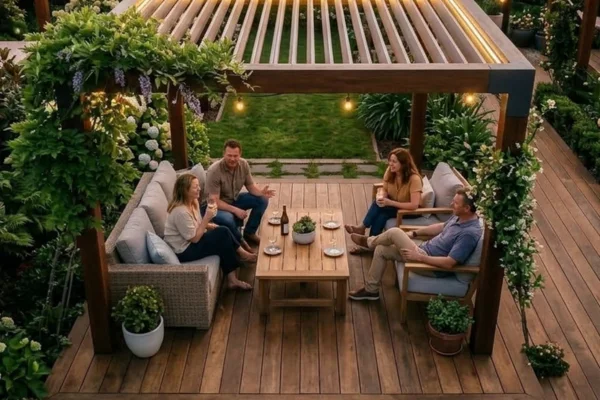
Three factors account for nearly all the cost of building a pergola, which is generally quoted between $5,000 and $30,000.
Size. Cost doesn’t scale in a straight line for pergola installation cost estimates — smaller structures carry a higher per-square-foot cost because fixed expenses (permits, footings, mobilization) don’t shrink proportionally. And buying material for a larger project can bring discounts that make materials nearly comparable to what a smaller project could get.
Material.
- Pressure-treated pine — lowest upfront cost, but needs annual sealing and is prone to checking and warping under repeated heat cycling.
- Cedar — better looks and natural rot resistance, still needs regular maintenance in high humidity.
- Aluminum — 30–50% more upfront than comparable wood, but doesn’t rot, warp, or fade, which often makes it the cheaper option over a 10–20 year hold.
- High-density composite (TimberTech, AZEK) — wood-like appearance with much better moisture, UV, and insect resistance than natural lumber.
Labor and site conditions. Labor typically runs 40–55% of total installed cost in the Brazos Valley. Expansive clay soil is the biggest local cost adder: a footing that would run 24–30 inches deep in stable soil often needs to go 36–48 inches here to keep posts from heaving as the ground shifts from wet to dry.
Special Note: Some College Station and Bryan neighborhoods also have HOA design review requirements for outdoor structures, so check deed restrictions before finalizing a design—a redesign after HOA rejection costs far more than the five minutes it takes to check upfront.
Quick Reference: Cost Per Square Foot
| Material | Cost per Sq. Ft. Installed |
| Pressure-treated pine | $40 – $60 |
| Cedar | $55 – $85 |
| High-density composite | $65 – $100 |
| Aluminum (louvered) | $85 – $140+ |
Use this to sanity-check any bid: multiply your desired footprint by the low and high end of a material’s range to get a rough target before you request quotes.
Get an Exact Price for Your Yard — Not Just a Range
Every number in this guide is a starting point. The real number depends on your lot’s soil, your home’s layout, and the size that actually fits your space. College Station Deck Builders will walk your property, take hands-on measurements, and then give you a written estimate — free, no pressure, no obligation.

Cost of Building a Pergola by Size
12×12 Pergola
A 144-square-foot footprint — enough to cover a four-person dining set with clearance to spare.
| Material | Installed Cost |
| Pressure-treated pine | $5,500 – $9,000 |
| Cedar | $8,000 – $13,000 |
| Composite or aluminum | $10,000 – $18,000 |
Footing depth and post sizing still need to be engineered correctly at this size — clay soil doesn’t care that the structure is small.
20×20 Pergola
At 400 square feet, this is the most-requested size in the Brazos Valley and generally delivers the best cost-per-square-foot value.
| Material | Installed Cost |
| Pressure-treated pine | $12,000 – $18,000 |
| Cedar | $15,000 – $22,000 |
| Aluminum (louvered) | $22,000 – $35,000+ |
Figures assume a freestanding structure, standard footings, and no electrical integration. A 30–40% shade canopy paired with a ceiling fan can drop perceived surface temperature by 15–25°F on a deck that would otherwise hit 140°F+ in direct July sun — the difference between a space that gets used and one that doesn’t.
Maintenance Cost Over 10 Years
The upfront price tells only part of the story. Ongoing maintenance in this climate can flip which material is actually cheaper over time.
| Material | Typical Annual Maintenance | 10-Year Maintenance Cost | Expected Refinish/Replace Point |
| Pressure-treated pine | Annual sealing, spot repairs | $600 – $1,200 | Refinish or partial rebuild by year 8–10 |
| Cedar | Sealing every 1–2 years, occasional board replacement | $500 – $1,000 | Refinish by year 10–12 |
| High-density composite | Periodic cleaning, minimal sealing | $100 – $300 | No refinish needed within 15+ years |
| Aluminum | Occasional cleaning | $50 – $150 | No refinish needed within 20+ years |
A pressure-treated pergola with a lower sticker price can cost as much as, or more than, an aluminum structure once you factor in a decade of upkeep — a point worth raising with homeowners comparing bids on price alone.
Kit vs. Professionally Built: The Real Cost of Building a Pergola
A retail pergola kit runs $1,500–$6,000 for materials alone, which looks like a big discount until you price in what it doesn’t include.
| Kit | Professionally Built | |
| Materials | $1,500 – $6,000 | Included in total |
| Assembly labor (if hired out) | $1,500 – $4,000 | Included in total |
| Concrete footings engineered for clay soil | Not included | Included |
| Wind-zone-rated post anchors | Not included | Included |
| Code compliance/permit handling | Not included | Included |
| Typical lifespan (Brazos Valley conditions) | 5–8 years before structural issues | 15–25 years |
Once footings, permits, and hardware are added to a kit, the price gap narrows substantially — and a kit anchored with surface-mounted post bases is genuinely vulnerable to the seasonal soil movement common throughout College Station and Bryan.
Does a Pergola Add Resale Value?
Outdoor living upgrades consistently deliver strong returns, and industry data on comparable projects puts pergola ROI in the 50–80% of cost range at resale—higher when the pergola is integrated with a deck, kitchen, or pool surround. On a $20,000 build, that’s roughly $10,000–$16,000 in added appraised value.
In the College Station/Bryan market specifically, buyers connected to Texas A&M — many relocating from out of state — actively prioritize usable outdoor space. A pergola built with durable materials and proper footings holds that value at resale; one showing checking and warping at listing time does not.
What actually moves the ROI needle:
- Material condition at time of sale — a weathered pressure-treated structure appraises closer to a landscaping feature than a functional addition; a composite or aluminum structure that still looks new reads as a durable asset.
- Integration with existing outdoor space — a pergola tied into a deck, patio, or kitchen tends to appraise higher than a standalone structure in the middle of the yard.
- Documented permits and engineering — buyers’ inspectors and appraisers both respond better to a structure with a permit history than one that was never permitted.
Add-Ons That Change the Total Cost of Building a Pergola
| Feature | Added Cost |
| Polycarbonate roof panels | $1,500 – $4,000 |
| Motorized louvered aluminum roof | $5,000 – $12,000 |
| Electrical rough-in (fans, lighting, outlets) | $800 – $2,500 |
| Outdoor-rated ceiling fan, installed | $150 – $600 per unit |
Running electrical during the initial build is significantly cheaper than retrofitting afterward — worth deciding on upfront even if you don’t install every fixture immediately.
Choosing a Contractor
Texas doesn’t license general contractors at the state level — TDLR only licenses specific trades like electrical, plumbing, and HVAC, not general construction. That makes your own vetting more important, not less. Look for:
- Registration with the relevant city (College Station and Bryan both have permitting requirements for structures like this)
- Current general liability insurance
- A written scope of work specifying footing depth, post size, beam dimensions, and material grade — not just a lump-sum total
- Completed local projects you can actually see, not just photos from other climates
Texas construction conditions are specific enough that experience in a different region doesn’t necessarily transfer to Brazos Valley clay soil and heat.
Questions worth asking before you sign:
- How deep will the footings go, and how did you determine that depth for this specific lot?
- What’s the post spacing and beam span for the size we’re discussing?
- Does the proposal include the material grade and hardware specs, or is it just a total price?
- Can I see two or three completed projects in College Station or Bryan specifically?
- Who pulls the permit, and is that cost included in the quote?
The Bottom Line
The cost of building a pergola in College Station runs $5,000 for a modest pressure-treated build to $30,000+ for a fully featured aluminum or composite outdoor room. What doesn’t change across that range is the baseline: footings deep enough for clay soil, correctly sized structural members, and materials suited to Texas heat and humidity. Skipping any of those to save money upfront often costs more within five years.
A pergola built right for College Station will still be standing — and still worth something — in 20 years. One built wrong will show it within three summers. The difference isn’t luck. It’s footings sized for clay soil, materials rated for Texas heat, and a contractor who’s actually built here before.
You don’t have to guess where your project lands in the pergola price range. College Station Deck Builders offers free on-site design consultations — we’ll measure your space, walk you through material options that fit your budget, and give you a detailed written estimate on the spot.
Frequently Asked Questions
How much does it cost to build a pergola in College Station, TX?
Typically $5,000 to $30,000+, depending on size, material, and site conditions. A 10×10 or 12×12 pressure-treated structure generally runs $5,000–$12,000; a 20×20 in cedar, composite, or aluminum runs $15,000–$30,000+ with features like motorized louvers or integrated lighting.
Is it cheaper to buy a pergola kit or have one built professionally?
A kit costs less upfront, but once you add labor, engineered footings, permits, and code-compliant hardware, the total gap narrows significantly — and kits aren’t engineered for Brazos Valley clay soil, which shortens their functional lifespan.
How much value does a pergola add to a home in College Station?
Industry data on comparable outdoor living projects puts pergola ROI around 50–80% of installed cost — roughly $10,000–$16,000 on a $20,000 project. Outdoor living space is a strong selling point in this market given the concentration of Texas A&M-connected buyers.
What’s the best pergola material for Texas heat and humidity?
Aluminum performs best — it doesn’t rot, warp, or degrade under UV exposure. High-density composite (TimberTech, AZEK) is a strong second choice at a lower price point than full aluminum. Pressure-treated pine is the most affordable but requires consistent annual maintenance.
How deep do pergola footings need to be in College Station?
Typically 36–48 inches, versus the 24–30 inches common in more stable soil markets. Brazos Valley clay expands and contracts seasonally, and shallow footings are the most common cause of post heave and structural failure over time.